Globally, donation is a process from developed nations to developing country to help the people in need. However, most donations are end up with conflict of interest, prescribed international expert and high rate of interest that become burden for the developing country like Bangladesh. Moreover, the donor agency like UN has a high cost to pay the international employees where hardly there is any representation of the native community. Consequently, there is hardly mentionable community impact in the field level. For example, UNESCO pay the highest level of salary to its permanent staff including pension and other benefit whereas, local staff are casual without any pension or health insurance.
Arguably, when a donation process from the donor country, they place their objective which may not align with destination community. Subsequently, they have their own arrangement of the experts who suppose to be highly paid and not necessary they are qualified enough to back stop the project. Majority have a few field visits where they have limited queries from the community to perceive and afterwards, they go back home to develop strategy. In contrast, local experts are more convenient to understand the local communication and field situation but are poorly paid which marginalizes the empowerment of destination community. From the empowerment view such donations make the locals dependent and loose their self-esteem to safeguard their heritage identity. Other than UN, financial donor like World Bank or ADB have their invest for interest cycle which remains a big drain for the national development of Bangladesh.
Contextually, monetary donations is one kind of support that can empower its recipients by providing them with financial resources to have more power and control over their situation (Bekkers & Wiepking, 2011; Vohs et al., 2006). However, the extent to which donation empower community id debatable based on their potential to produce socio-cultural change (for similar arguments in the context of refugees and poor communities, see Becker et al., 2022; Jackson & Esses, 2000; Khanom et al;2019). Bareket et al (2022) coined the issue on domestic and business context where is less chance to have change in domestic role to empower women compare the business reinforce more social changes to increase the percentage of women. Generally, this sort of empowerment is economic, and we want to introduce cultural empowerment to enhance women participation in domestic and business. Cultural empowerment is a concept invented through tourism to empower marginalized community like women and indigenous people. From an intangible heritage point of view, women are the bearer of the creative industry, festive, ritual, oral story and music to offer potential through business and tourism. As such, business in a developing country always is a subject of middleman who take the major share since there is less formal structure for investor (guest) and host community.
Monetary donations can provide resources, but their ability to produce socio-cultural change is debatable. Cultural empowerment focuses on enhancing women’s participation in domestic and business life.
Women are the bearers of creative industries, rituals, oral stories, and music — offering potential through business and tourism. However, middlemen often exploit these opportunities due to weak formal structures.

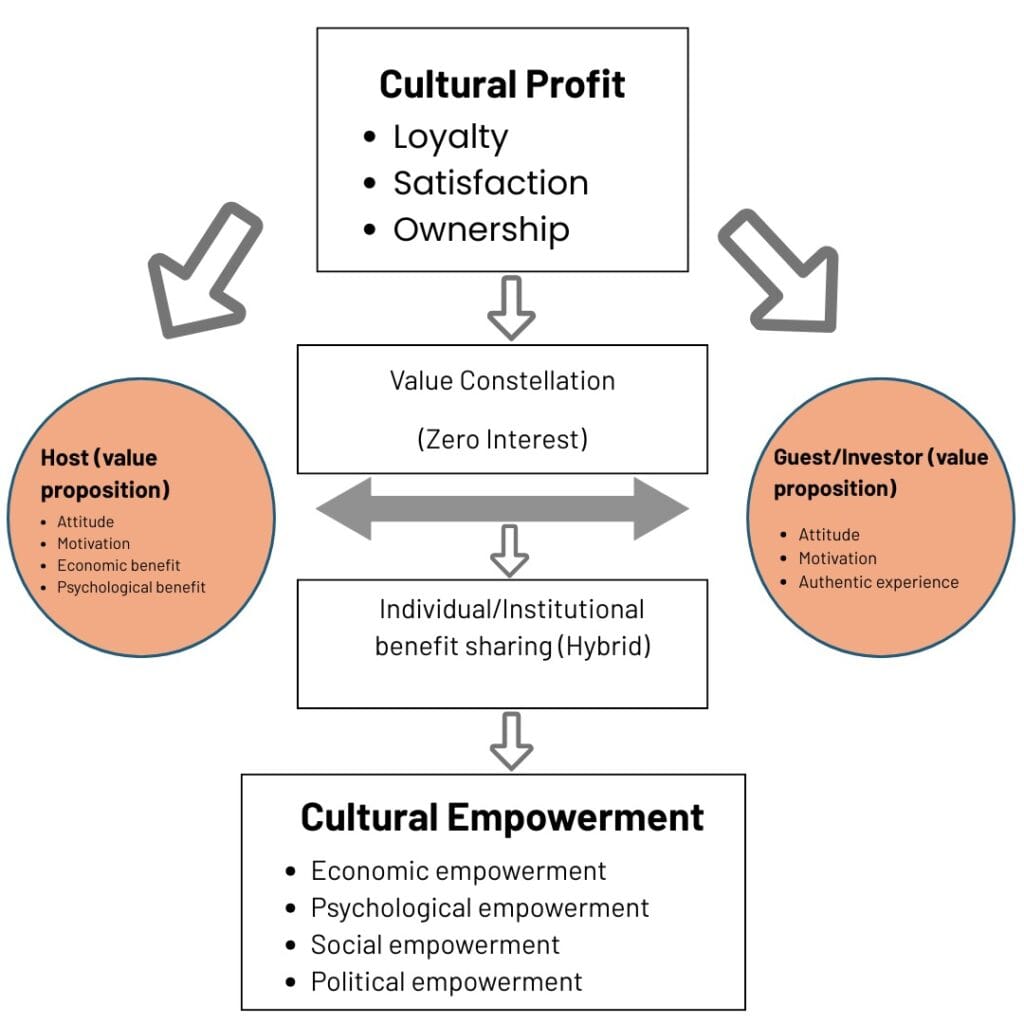
Modality of Social Businesses
E.g. The product produced is for the benefit of the poor. Those who will contribute 50,000 to 200,000 taka that will be countable as donation and subsequently no benefit.
E.g. The product could be produced by the poor but exported to an international market while net profits would go towards workers benefits.
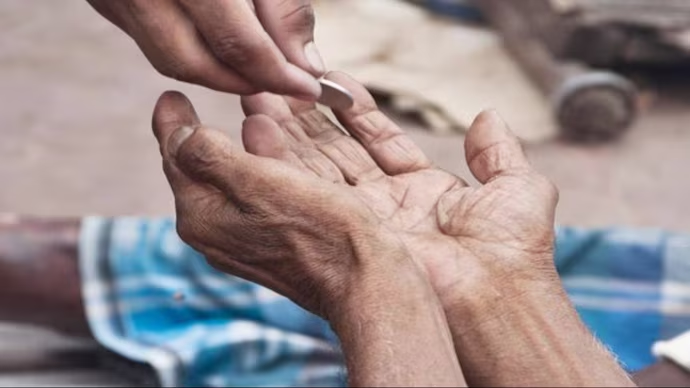
Although the legal age of adulthood in our country is 18, we remain dependent on our fathers indefinitely. Fathers are expected to complete our education, find us a job, and arrange our marriage. In a poor country like ours, where most people are working-class and impoverished, fathers do not have two-thirds of their property to pass on. Even the middle class is in a dire state, as their salary is barely enough to support their wives, children, parents, siblings, and relatives. We do not have any family-based savings programmes, which is why many people spend everything and then have to beg for more. From a young age, we are not taught to budget or save with a priority system. I have noticed that most boys cannot save money and end up borrowing to support their extended families. Beyond family, there are our region-based various hospitality and protocol traditions, such as dowries, iftar meals, Jamai Shasthi (son-in-law’s celebration), mango-jackfruit celebrations, and Eid festivals. In almost every celebration, there is a lot of exchange of clothes, food, and money in the bride’s family. I believe that excessive spending on food and money under the guise of hospitality is putting our social security in jeopardy. We are no longer in the era of Shaista Khan, when one could buy eight maunds of rice for a single taka. Now, we carry an endless burden of debt, and we consider begging to be a source of pride. The leading headlines in our newspapers focus on how much ‘alms’ different countries are giving. We need a project titled ‘We will not die begging!’ The aim of this project would be to stop family-based begging and ensure cultural and collective empowerment. Finally, we must understand that helping someone and begging are two entirely different things.