
Background
Experiential education is a transformative philosophy in which learners engage in direct experiences and reflective practice. This approach enhances knowledge, develops practical skills, and strengthens individuals’ ability to contribute meaningfully to society. Education, therefore, should not merely focus on academic achievement but also on cultivating innovation, empathy, cultural awareness, and social responsibility.
In this context, it is important to recognize that formal education is not the only pathway to intellectual excellence. South Asian heritage offers compelling examples of individuals whose genius emerged through lived experience, self-learning, and cultural immersion.
At present, fully developed flexible education models that accommodate exceptional talents within mainstream systems remain limited. As an initial step, however, storytelling methodologies can be introduced to amplify the voices of individuals with lived experiences and unique intellectual perspectives—fostering identity construction for cultural empowerment
Cultural Identity Construction and Education: Empowerment
From a heritage perspective, I acknowledge the University of Dhaka, the highest-ranked national university and the first university established in Bangladesh during the British colonial period in 1921. This university has played a pioneering role in key historical and political movements, including the Language Movement (1952), the Liberation War (1971), and more recently, the July Revolution of 2024, thereby contributing significantly to the legacy of national identity and empowerment. However, a recent review of the university’s website suggests that its information is scattered, incomplete, and not well integrated to meet international standards.
For example, some faculty profiles do not include photographs, while others lack publication records. The presentation of faculty profiles is weak and does not include professional digital identifiers such as LinkedIn or ORCID IDs.
Furthermore, achievements related to funding, awards, and research recognition are often absent (Dhaka University, 2026). Despite having a computer science faculty, it is surprising that the institution remains significantly incompatible with international standards of visibility and digital integration.
Although access to high-impact journals is vital for research, the university website does not provide a clearly structured, centralized platform for high-impact international journals. Also, the mixture of Bengali and English content may limit accessibility for diverse audiences.
Doubtfully, the website also lacks a clearly visible freedom of expression policy, which is a fundamental tool for faculty accountability and curriculum evaluation. Such gaps limit students’ opportunities to participate in evaluating teachers and academic systems. This issue is not only local but also reflects a wider global challenge.
For example, universities often establish panels of academics to interview and select potential faculty members. However, the appointed faculty may not always be well-received by students in terms of course delivery, communication, and supervision. Therefore, students should be given opportunities for mutual evaluation of both faculty performance and curriculum effectiveness as an integral part of freedom of expression.
Beyond freedom of expression, a gender-based violence policy is urgently needed to ensure the safety of both male and female students on campus. Cases of sexual violence involving female students on university campuses, including at Jahangirnagar University (The Daily Star, 2026), reveal the pressing need for stronger institutional safety and protection mechanisms.
To protect female students, a balanced security team composed of both men and women (60%) should be deployed on a 24-hour basis, like other international campuses such as the Asian Institute of Technology (Bangkok), where I pursued my Master’s. To enhance student safety, mobile-based emergency alarm systems—modeled on those used by UN agencies—may be implemented within educational institutions.
As well, periodic workshops and evaluations should be conducted to address freedom of expression, mutual evaluation, security concerns, and strengthen awareness. As such, ragging remains a serious threat in many public universities and has resulted in tragic consequences, including the killing of the brilliant student Abrar Fahad at Bangladesh University of Engineering and Technology (The Daily Star, 2019) during the fascist Hasina era.
Despite ongoing discussions on educational reform, universities in Bangladesh still follow divided admission structures across engineering, medical, arts, and humanities disciplines. Such fragmentation may restrict interdisciplinary innovation and reflect the absence of a coordinated national admission framework.
Some universities argue that centralized admissions may reduce their ability to identify qualified students according to their institutional standards. Nevertheless, there are also concerns that universities generate substantial revenue from faculty-based admission examination fees, which often involve significant financial benefits for the faculties and institutions involved.
As universities operate under the authority of the University Grants Commission of Bangladesh and the Ministry of Education, there is still limited clarity on their website about why a unified admission platform has not been effectively implemented (UGC, 2026).
Bangladesh currently has more than 110 approved private universities. However, parts of the private education sector have also been criticized for corruption, political influence, and weak regulatory oversight. Allegations regarding irregular licensing practices and excessive tuition fees continue to raise concerns about accountability and educational quality.
Debatably, faculty recruitment remains one of the most sensitive areas of corruption within the majority parts of the public university system in Bangladesh. Drawing on my undergraduate experience at Khulna University from 1997 to 2002, I achieved a strong academic record with distinction; however, I was advised that a political recommendation was necessary for faculty appointment. Such experiences demonstrate how merit-based academic culture can be undermined by political influence and patronage.
Apart from recruitment, alumni engagement is frequently weakly defined, with minimal acknowledgment of significant alumni contributions on university websites such as Dhaka and Khulna universities.
The Urgency of an International Research Entity: UN Human Rights and Women Cultural Empowerment International (WCEI)
The July 2024 student movements in Bangladesh focused heavily on quota reform, yet insufficient attention was given to transparent faculty recruitment systems. Without fair recruitment, educational systems risk promoting dependency and political favoritism rather than innovation and intellectual collaboration.
Regarding such corruption, I believe that the United Nations Human Rights Council should take a stronger role in supporting the development of an Independent International Research entity to address educational challenges, particularly in developing countries like Bangladesh.
Notably, WCEI is interested in collaborating with the UN Human Rights to structure an independent research entity to backstop native innovation.
For example, the Australian Research Council (ARC) has demonstrated an effective international research funding platform across Asia. Recently, it provided significant funding support ($3729300) to researchers at Griffith University (where I pursued my PhD) to develop carbon-smart nut industries and sustainable innovation initiatives (Make It Matter, 2026).
Apart from higher education, primary and secondary education are also at risk of failing to produce innovation-based learning outcomes. The main branches of education include madrasa, public, and English-medium systems. Although extensive discussions have taken place, no government has successfully achieved meaningful integration in curricula or teaching modalities across these streams.
Likewise, a recent report indicated that an Imam (mentor) at a women’s madrasa allegedly sexually assaulted an 11-year-old girl, resulting in pregnancy. Arguably, while the veil system is often presented as a measure of security for women, such incidents raise serious questions about its effectiveness in ensuring safety within the madrasa system (The Daily Star, 2026).
As such, to navigate higher education opportunities, Bangladesh heavily relies on international ranking systems such as Times Higher Education rankings. However, very few or no Bangladeshi universities achieve strong global positions. Therefore, Bangladesh should also consider developing a credible national ranking framework to help students make informed educational choices and also give a clear message to international universities.
Beyond formal education, skill-based training should also be recognized as part of living heritage to identify exceptional talents. Living heritage practices such as music, storytelling, dance, and painting can significantly support students’ psychological well-being while also creating opportunities for heritage-based entrepreneurship.
Students can engage with creative industries at home, through extended family mentorship, and in schools to preserve and transmit indigenous knowledge while developing heritage-based entrepreneurship initiatives for digital marketing.
Importantly, global education systems are often shaped primarily by education specialists rather than health practitioners or psychologists. As a result, many students struggle to maintain a healthy balance between academic pressure and personal well-being.
Such evidence highlights the urgent need for educational systems to integrate living heritage, mental health, and well-being perspectives into curriculum design and assessment practices.
Transforming Education into Empowerment: Bangladesh Civil Service (BCS) in the Absence of Innovation
In Bangladesh, one of the most preferred career paths after graduation is the Bangladesh Civil Service (BCS) Examination system, which heavily emphasizes memorization rather than innovation.
Success in the BCS examination is often treated as the primary indicator of intellectual achievement and social status. As a result, alternative talents such as entrepreneurship, artistic innovation, technological creativity, research potential, and social leadership receive less recognition.
A large coaching industry has developed around BCS preparation. Many students spend years preparing for examinations instead of engaging in practical training, internships, fieldwork, or innovative projects. This creates dependency on exam-oriented learning rather than experiential education and innovation.
Moreover, civil service cadres are often perceived as holding a high level of social status, which can reinforce dominant power structures and contribute to concerns about harassment, particularly in relation to journalists.
For example, the case of Rozina, a journalist of Prothom Alo who was allegedly subjected to severe abuse during the Hasina regime, has been widely reported (The Daily Star, 2023). This, in turn, may discourage broader community participation, including that of journalists, in government mechanisms.
In the context of government mechanisms, the Ministry’s expert recruitment procedures are not clearly defined. For example, there is an apparent lack of structured Open-Call mechanisms for academic or institutional engagement within the Ministry of Education (MoE, 2026), where selection practices often depend on informal relationships or political considerations.
We recommend that the UN Human Rights might develop the Call for Contribution model through a Public–Private Partnership (PPP), which refers to a cooperative arrangement between the government (public sector) and private organizations (private sector) to deliver services or implement projects that are typically provided by the state.
Such direct engagement could advance the concept of Cultural Rights and foster empowerment. Therefore, the Special Rapporteur could also engage with the Australian Research Council and similar organizations to facilitate dialogue and gather suggestions for strengthening research-based policy development.
To conclude, on behalf of WCEI, I affirm our commitment to advancing the work of UN Human Rights and our openness to collaboration in education, heritage, culture, conservation, and empowerment.
Quote 274: Nobel Laureate Muhammad Yunus, Poverty
“We can remove poverty from the surface of the earth only if we can redesign our institutions, like the banking institutions, and other institutions; if we redesign our policies, if we look back on our concepts, so that we have a different idea of poor people”.
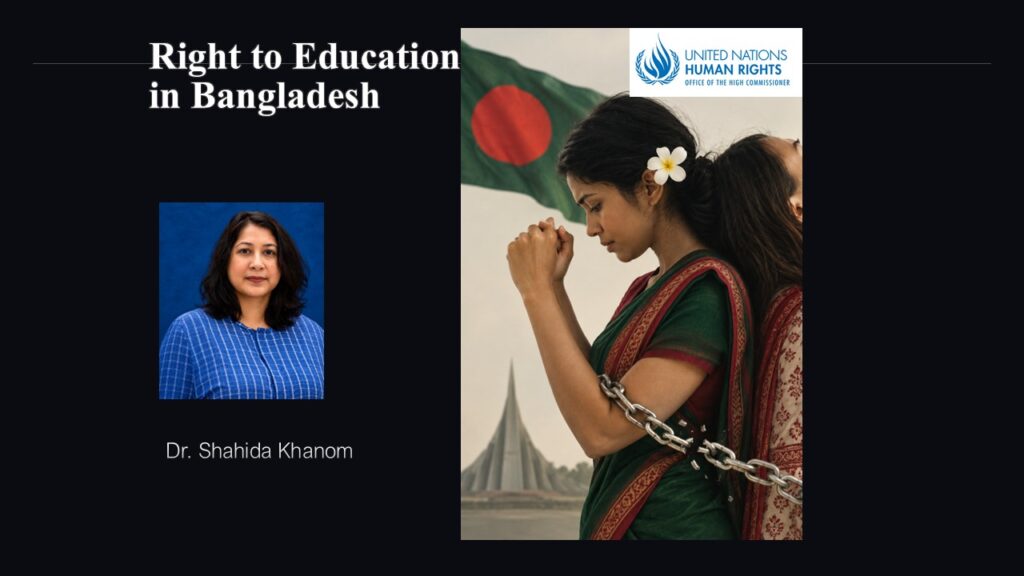
Dr. Shahida Khanom
CEO and Founder
Women Cultural Empowerment International
Website: https://wceia.org/